


Agriculture is the backbone of India’s economy, contributing significantly to GDP and employment. To modernize and strengthen this sector, the Indian government launched the Agricultural Infrastructure Fund (AIF) — a revolutionary step towards creating robust infrastructure and enhancing agricultural value chains.
Key Highlights of the Agricultural Infrastructure Fund
The AIF aims to:
· Develop post-harvest management infrastructure like warehouses, cold storage, and processing facilities.
· Promote logistics and marketing facilities, ensuring minimal waste and higher farmer income.
· Facilitate credit availability to farmers, cooperatives, FPOs (Farmer Producer Organizations), startups, and entrepreneurs.
Salient Features of the AIF Scheme
1. Financial Allocation
Key financial components of the scheme include:
· Fund Size: ₹1 lakh crore allocated for financing agricultural infrastructure projects.
· Disbursement Period: Spread over 4 years (2020–2024).
· Interest Subvention: 3% per annum for loans up to ₹2 crore for a maximum of 7 years.
· Credit Guarantee Coverage: Through the Credit Guarantee Fund Trust for Micro and Small Enterprises (CGTMSE).
2. Focus Areas
The scheme targets the following:
· Building storage facilities to reduce post-harvest losses.
· Establishing value-addition infrastructure for agro-processing.
· Facilitating projects aligned with government schemes like PM-KUSUM for solar-based irrigation.
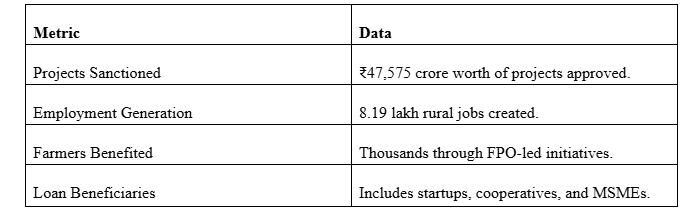
Impact Achieved So Far
Key Enhancements in the Scheme
Recent approvals have added significant value to the AIF framework:
· Increased Credit Guarantee: FPOs can now access higher credit limits without collateral.
· Integration with Existing Programs: Strong alignment with schemes like PM-Kisan and PM-KUSUM to boost farmer welfare.
· Digital Applications: Simplified procedures for application, approval, and monitoring via online portals.
A Path Towards Agricultural Sustainability
The AIF envisions:
· Reducing Food Wastage: Through state-of-the-art storage and logistics.
· Empowering Farmers: By connecting them with markets and offering fair prices.
· Encouraging Agri-Entrepreneurship: With startup-friendly policies and funding.
Future Outlook and Recommendations
While the AIF is already a game-changer, further efforts can amplify its reach:
· Awareness Campaigns: Educating farmers and rural entrepreneurs about the scheme.
· Strengthening FPOs: Encouraging group-based infrastructure models for collective benefit.
· Technology Integration: Promoting AI and IoT-based solutions for real-time monitoring.
Conclusion
The Agricultural Infrastructure Fund is a testament to India’s commitment to transforming agriculture. By blending financial support with innovation, the AIF has laid the foundation for sustainable growth and self-reliance in the sector. With continued efforts, this initiative promises a brighter future for Indian farmers and the agricultural economy.