


India is one of the world’s leading agricultural producers, but a large portion of its harvest is lost due to inadequate processing and storage infrastructure. To tackle this issue, the Pradhan Mantri Kisan Sampada Yojana (PMKSY) was launched by the Ministry of Food Processing Industries (MoFPI). This flagship scheme aims to revolutionize the food processing landscape by strengthening infrastructure and streamlining supply chains across the country.
Objectives of PMKSY
PMKSY is focused on modernizing and expanding India’s food processing ecosystem by:
- Establishing world-class infrastructure, including mega food parks, cold chain networks, and agro-processing clusters.
- Creating strong backward and forward linkages to connect farmers with processors, retailers, and markets.
- Developing a robust supply chain for perishables — from the farm gate to the retail shelf — to minimize post-harvest losses.
By addressing key bottlenecks in the food value chain, PMKSY plays a pivotal role in doubling farmers’ incomes, reducing food wastage, and boosting India's exports in processed food products.
Key Features of PMKSY
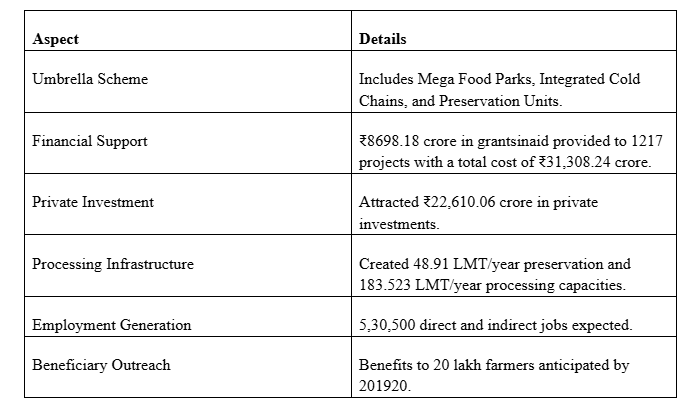
Key Schemes Under PMKSY
The Pradhan Mantri Kisan Sampada Yojana comprises several sub-schemes designed to build a holistic and integrated food processing ecosystem:
- Mega Food Parks: Facilitate cluster-based development of food processing industries by offering shared infrastructure such as cold storage, testing labs, and packaging facilities—boosting economies of scale.
- Integrated Cold Chain and Value Addition Infrastructure: Reduce post-harvest losses by developing efficient cold chains, warehousing, and temperature-controlled storage from the farm gate to the consumer.
- Food Processing and Preservation Units: Provide financial support for setting up and modernizing individual food processing units to increase shelf life and add value to perishable commodities.
- Agro-Processing Clusters: Promote group-based development of processing industries in rural areas, enhancing productivity and local employment opportunities.
- Backward and Forward Linkages: Strengthen the farm-to-market ecosystem by connecting producers directly with processors and retailers, improving farmers’ income and market access.
- Food Safety and Quality Assurance Infrastructure: Ensure that processed food meets national and international safety and quality standards through testing labs, certification facilities, and quality control mechanisms.
- Human Resources and Institutions: Develop skilled professionals through training programs and capacity-building initiatives to support and sustain the growing food processing sector.
Achievements of PMKSY
PMKSY has achieved remarkable milestones since its inception:
- Infrastructure Development: 651 out of 1217 approved projects completed, creating significant preservation and processing capacities.
- Economic Impact: ₹31,400 crore investment expected for handling 334 LMT agro produce valued at ₹1,04,125 crore.
- Employment Creation: Over 5,30,500 jobs generated.
Benefits to Farmers
PMKSY plays a critical role in connecting farmers to markets by:
- Reducing wastage of agricultural produce.
- Enhancing the shelf life of perishable items through modern processing techniques.
- Ensuring better price realization and steady revenue.
State Level Implementation
The scheme's projects are spread across 17 states, leveraging ₹406 crore in investments. These projects have significantly boosted rural employment and empowered farmers, highlighting the scheme's transformative impact.
Conclusion
The Pradhan Mantri Kisan Sampada Yojana is a game-changer for India's agricultural and food processing sectors. By modernizing infrastructure, fostering investment, and improving market linkages, PMKSY ensures that farmers benefit from their hard work. It represents a crucial step in reducing food wastage, creating jobs, and boosting India's economy while positioning the country as a global leader in food processing. PMKSY is not just a policy—it is a visionary initiative that bridges the gap between agriculture and industry, empowering farmers and ensuring sustainable growth for generations to come.