


Modern plant breeding techniques have brought revolutionary changes to crop improvement, enabling higher yields, enhanced resistance to diseases, and better adaptability to environmental conditions. Unlike traditional methods that relied mainly on phenotypic selection, these advanced techniques employ molecular markers, gene editing, and artificial intelligence to enhance genetic diversity and efficiency in breeding processes. This blog provides an overview of key modern plant breeding techniques and their impact on agriculture.
Key Techniques in Modern Plant Breeding
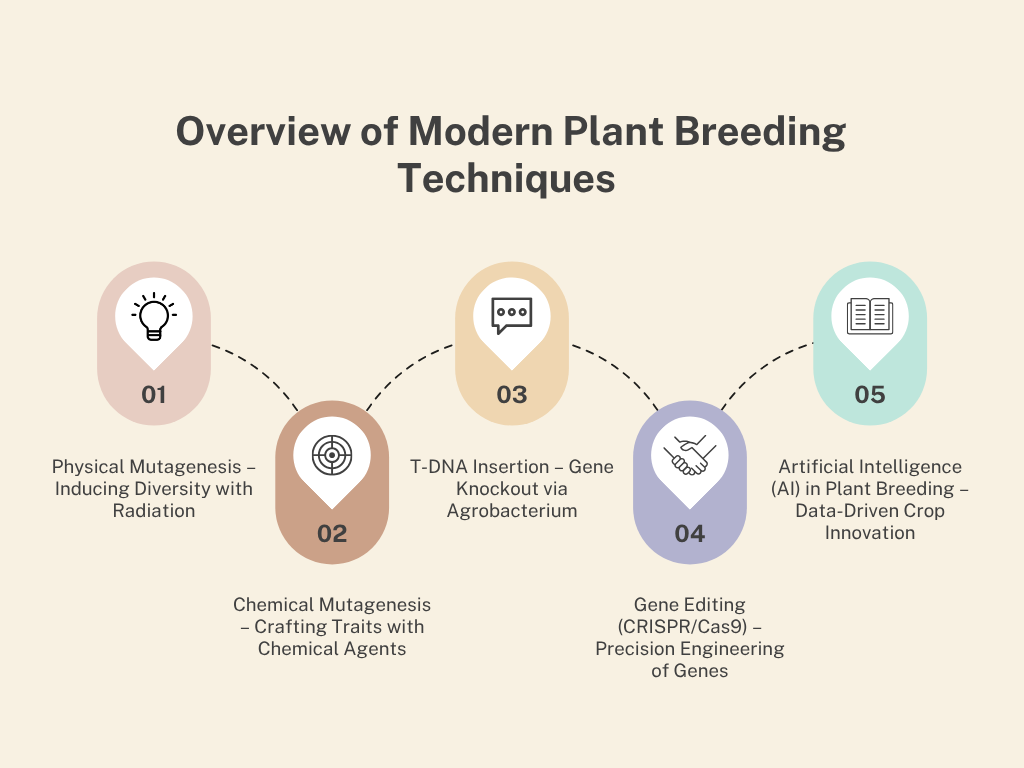
Overview of Modern Plant Breeding Techniques
1. Physical Mutagenesis – Inducing Diversity with Radiation
What it is:
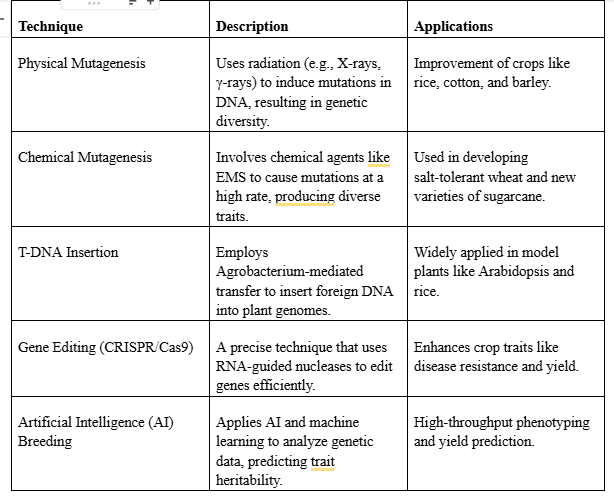
Physical mutagenesis involves exposing plant seeds or tissues to physical agents like X-rays, gamma rays (γ-rays), or ultraviolet (UV) light to create random changes in the DNA.
How it works:
These high-energy rays penetrate plant cells and cause mutations by breaking or altering DNA strands. While the changes are random, they can introduce valuable traits that wouldn't naturally occur through traditional breeding.
Applications:
Over 1,700 mutant crop varieties have been developed globally using this technique.
It has helped improve plant height, maturity time, grain size, and disease resistance in crops like rice, barley, cotton, and groundnut.
Limitations:
Since mutations are random, breeders must grow and screen thousands of plants to find useful traits.
The process is time-consuming and requires specialized facilities for handling radiation.
2. Chemical Mutagenesis – Crafting Traits with Chemical Agents
What it is:
Chemical mutagenesis uses chemical substances—like Ethyl Methanesulfonate (EMS), sodium azide, or nitrosoguanidine—to alter a plant’s DNA, causing point mutations.
How it works:
These chemicals bind to DNA and cause subtle base-pair changes, which may lead to the creation of dominant or recessive traits.
Applications:
- Widely used to develop salt-tolerant wheat, improved sugarcane varieties, and early-maturing crops.
- EMS is popular for its high mutation frequency and efficiency in generating trait variability.
Limitations:
- Like physical mutagenesis, it’s a random process—requiring large-scale screening.
- Safety precautions are necessary due to the toxic nature of some mutagens.
3. T-DNA Insertion – Gene Knockout via Agrobacterium
What it is:
T-DNA (Transfer DNA) insertion is a biological method that uses the natural ability of Agrobacterium tumefaciens, a soil bacterium, to insert a segment of DNA into a plant’s genome.
How it works:
The bacterium is genetically modified to carry a desired gene (or marker), which it transfers into plant cells. This insertion often disrupts existing genes, allowing researchers to study their functions or create desired traits.
Applications:
- Used extensively in research crops like Arabidopsis and rice.
- Helps in gene function analysis, trait mapping, and crop improvement.
Limitations:
- Primarily used in lab settings; less scalable for commercial crop development.
- Some public resistance due to its association with GMOs.
4. Gene Editing (CRISPR/Cas9) – Precision Engineering of Genes
What it is:
CRISPR (Clustered Regularly Interspaced Short Palindromic Repeats) is a revolutionary technique that enables precise, targeted modifications in a plant’s DNA.
How it works:
Using a guide RNA (gRNA), CRISPR/Cas9 locates the exact DNA sequence to be edited. The Cas9 enzyme then cuts the DNA at that point, allowing scientists to insert, delete, or replace specific genetic material.
Applications:
- Enhances traits like disease resistance, drought tolerance, pest resistance, and nutritional value.
- Already been used in rice, tomatoes, maize, and soybeans for improved productivity.
Advantages:
- High precision with minimal off-target effects.
- Faster and more cost-effective compared to traditional breeding or mutagenesis.
- Considered non-GMO in some countries when no foreign DNA is introduced.
Limitations:
- Regulatory uncertainties exist in many countries.
- Requires skilled personnel and sophisticated lab infrastructure.
5. Artificial Intelligence (AI) in Plant Breeding – Data-Driven Crop Innovation
What it is:
AI and machine learning tools are transforming how breeders analyze genomic, phenotypic, and environmental data to make informed breeding decisions.
How it works:
- AI models analyze large datasets to
- Predict how specific genes influence traits.
- Identify the best parental lines for crossing.
Accelerate trait selection through high-throughput phenotyping (using drones, sensors, imaging, etc.).
Applications:
- Used in yield prediction, disease forecasting, drought response analysis, and climate-resilient breeding.
- Platforms like Plantix, IBM Watson Decision Platform for Agriculture, and PhenoScout are revolutionizing farm data usage.
Advantages:
- Reduces trial-and-error in breeding.
- Enables faster and more accurate decision-making.
- Supports climate-smart agriculture through predictive modeling.
Conclusion
The integration of modern breeding techniques, such as molecular markers, CRISPR, and AI, has provided breeders with effective tools to improve crop resilience, productivity, and diversity. As these technologies continue to evolve, they promise to meet global food security challenges and contribute to sustainable agriculture. For students, understanding these advanced techniques is crucial for the future of agricultural sciences.