


The Government of India launched Operation Greens to ensure fair pricing for both farmers and consumers by reducing the price volatility of perishable agricultural commodities. This initiative, introduced in the Union Budget 2018-19, initially focused on Tomato, Onion, and Potato (TOP) and has since expanded to cover 41 perishable crops under the Aatmanirbhar Bharat Abhiyan.
Key Objectives
Operation Greens aims to:
- Stabilize prices of essential commodities to prevent extreme fluctuations.
- Reduce post-harvest losses by improving supply chain infrastructure.
- Encourage farmers to diversify into other crops, ensuring income security.
- Ensure affordability for consumers without compromising farmer profitability.
Key Features of Operation Greens
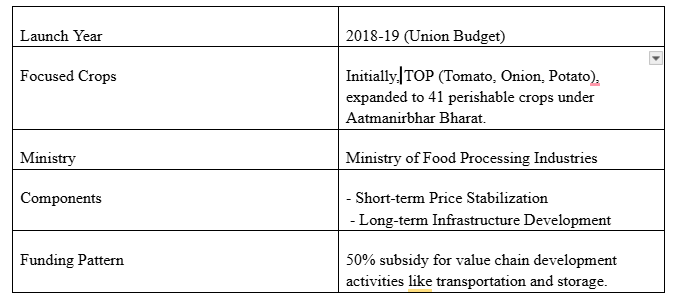
Components of the Scheme
Short-Term Measures: Price Stabilization
- Price Stabilization Fund (PSF): Aims to protect farmers from price crashes and consumers from inflated rates.
- Provides 50% subsidies on transportation and storage to control price surges during supply disruptions.
Long-Term Development
- Enhances cold storage facilities, food processing units, and logistics infrastructure.
- Establishes FPOs (Farmer Producer Organizations) for better market linkage.
- Promotes integrated value chains from farm to fork.
Expansion to total:
Initially focused on TOP crops, Operation Greens was expanded under the Aatmanirbhar Bharat Abhiyan in 2020 to include all fruits and vegetables for six months, allowing for broader stabilization efforts.
Grant-in-Aid:
- Subsidies of 50% for eligible projects, up to ₹50 crore.
- For FPOs, grant assistance increases to 70%.
Eligible Entities:
FPOs, cooperative societies, individual farmers, state federations, food processors, logistics operators, and exporters.
Progress and Expansion
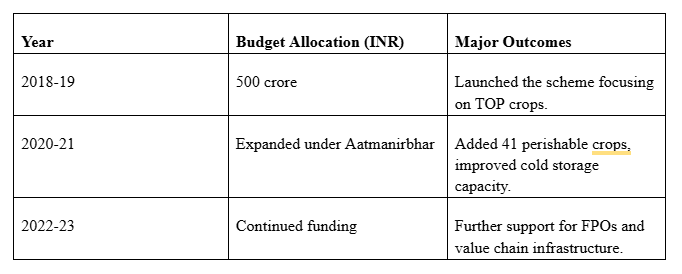
Operation Greens initially focused on reducing post-harvest losses and creating infrastructure for the TOP crops. Under the Aatmanirbhar Bharat Abhiyan, the scheme broadened its reach to cover 41 additional perishable items, including:
- Fruits like mango, banana, and guava.
- Vegetables such as cauliflower, brinjal, and capsicum.
- Spices like turmeric and ginger.
Budgetary Allocations and Impact
Challenges and Way Forward
Challenges:
- Lack of sufficient farmer awareness about the scheme's benefits.
- Uneven infrastructure development across states.
- High dependency on subsidies for short-term solutions.
Suggestions:
- Conduct extensive outreach programs for farmers.
- Invest in rural connectivity to bridge gaps in logistics.
- Expand the scheme’s monitoring mechanisms for effective implementation.
Conclusion
Operation Greens is a transformative step toward strengthening India's agricultural economy. By addressing price volatility, reducing post-harvest losses, and building robust market linkages, the scheme supports both farmers and consumers. Continued emphasis on infrastructure, farmer awareness, and seamless execution will ensure its long-term success.