

The Food Corporation of India (FCI), established on January 14, 1965, plays a critical role in implementing India's food policy through effective price support, procurement, storage, and distribution of food grains.
Key Objectives of FCI
- Provide effective price support operations to safeguard farmers' interests.
- Distribute food grains across India via the Public Distribution System (PDS).
- Maintain operational and buffer stock levels for national food security.
FCI's Core Functions
The primary functions of FCI include food grain procurement, transport management, and distribution under various schemes. Each function is vital for maintaining a steady and affordable food supply.
1. Procurement of Food Grains
The FCI undertakes extensive procurement of food grains, ensuring fair prices for farmers and building reserves for food security.
• Minimum Support Price (MSP): Announced before each crop season, MSP considers production costs, market rates, and inter-crop parity to protect farmers' interests.
• Procurement Centers: FCI and state agencies set up over 12,000 purchase centres annually, ensuring farmers need to travel no more than 10 km.
• Significant States: Major procurement operations occur in states like Punjab and Andhra Pradesh, paying billions to farmers for their produce.
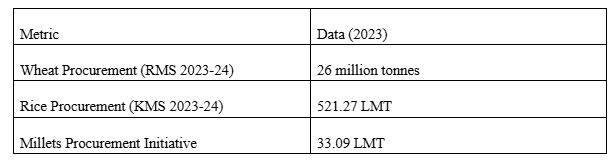
• Volume of Procurement: For 2023, FCI’s wheat procurement for the Rabi Marketing Season reached 26 million tonnes. Rice procurement for Kharif Marketing Season 2023-24 is estimated at 521.27 LMT.
2. Transport Management
Moving millions of tons of food grains across India, FCI’s transport operations are essential to food distribution.
- Logistics Network: Food grains are transported from surplus states in the north to deficit states.
- Daily Operations: Approximately 1.2 million bags (50 kg each) are transported every day.
- Modes of Transport: FCI utilizes rail, road, and inland waterways to reach states without rail links.
3. Distribution of Food Grains
FCI supports India's Public Distribution System (PDS) to provide affordable food grains across the country.
- Public Distribution System (PDS): Ensures food security by stabilizing prices.
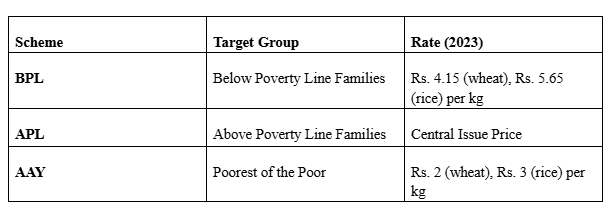
- Targeted Public Distribution System (TPDS): Divided into BPL and APL categories, with subsidized rates for food grains.
Funding and Financial Structure
• Capital Support: FCI’s operational expenses are supported by the Government of India.
• Bank Financing: Working capital for procurement and distribution is provided by a consortium of 44 banks.
• Subsidies: The difference between procurement costs and issue prices is covered by government subsidies, ensuring affordability for consumers under PDS.
Conclusion
The Food Corporation of India has played a pivotal role in strengthening India’s food security framework. From procurement to transport and distribution, FCI’s initiatives have supported farmers, stabilized food prices, and ensured that food grains reach every corner of the country. The PDS, TPDS, and AAY schemes, backed by government subsidies, make food accessible to economically vulnerable groups, fulfilling the goal of food security for all.