

The Paramparagat Krishi Vikas Yojana (PKVY), launched in 2015, is a flagship program under the National Mission on Sustainable Agriculture (NMSA). Designed to support organic farming, this initiative aims to promote eco-friendly agricultural practices, improve soil health, and empower farmers. This blog provides a detailed overview of PKVY, covering its objectives, components, funding patterns, and implementation strategies.
About the Scheme
PKVY operates as a component of the Soil Health Management (SHM) program under the NMSA. The scheme emphasizes the Participatory Guarantee System (PGS-India) for organic certification, which builds trust between producers and consumers. This domestic certification process eliminates the need for third-party certification, making it cost-effective and accessible to small and marginal farmers.
The scheme is funded in a 60:40 ratio by the Central and State Governments. For North Eastern and Himalayan states, the funding ratio is 90:10, and Union Territories receive 100% Central assistance. PKVY's ambitious goal is to establish 10,000 clusters covering 2 lakh hectares of agricultural land under organic farming.
Objectives of PKVY
The key objectives of PKVY are:
- Promote chemical-free, eco-friendly farming.
- Disseminate advanced organic farming techniques.
- Encourage the participation of rural youth, women, and farmers in organic agriculture.
- Enhance soil health through organic practices.
- Develop clusters for Participatory Guarantee System (PGS) certification.
Cluster-Based Approach
PKVY adopts a cluster-based approach, promoting organic farming in contiguous areas of 20 hectares (50 acres). Each cluster operates under the Participatory Guarantee System (PGS), enabling farmers to certify, label, and market their produce as organic. The conversion to organic farming occurs over a 36-month period.
Key Components and Activities
PKVY is structured into several components and activities aimed at fostering organic farming at the grassroots level. The main components include:
1. Model Organic Cluster Demonstrations
Activities under cluster demonstrations include:
- Mobilization of farmers into clusters of 20 hectares.
- Training and exposure visits for farmers to organic farming fields.
- Implementation of participatory certification through PGS-India.
- Development of organic input units for manure and bio-fertilizer production.
- Support for packaging, branding, and marketing of organic products.
2. Model Organic Farms
Model Organic Farms are established on a one-hectare plot to showcase the conversion from conventional farming to organic methods. These farms serve as demonstration units for training farmers on organic practices and production techniques.
Funding and Pattern of Assistance
PKVY provides financial assistance for various activities, ensuring a systematic transition to organic farming. The funding is allocated for cluster formation, certification, input procurement, and marketing support. Below is a detailed pattern of assistance for a 20-hectare cluster over three years.
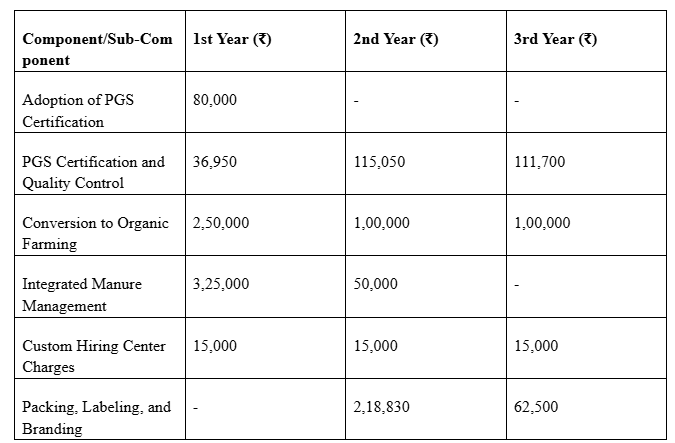
In total, financial assistance of ₹14.95 lakh per cluster is available for mobilization, certification, manure management, and marketing support. This includes a maximum subsidy of ₹50,000 per hectare for individual farmers.
Institutional Framework
PKVY operates through a multi-tier institutional framework involving national, state, district, and local functionaries. At the national level, the scheme is managed by the Department of Agriculture, Cooperation, and Farmers Welfare (DAC&FW). The National Centre of Organic Farming (NCOF) and its Regional Councils (RCs) handle implementation at the district level.
Roles and Responsibilities
The success of PKVY hinges on the effective participation of various stakeholders. Key roles include:
- District Collectors oversee the implementation of training and procurement activities.
- Regional Councils provide support for certification, quality control, and marketing.
- Local Groups (LGs) organize farmers, ensure compliance with organic standards, and maintain records.
Certification Process
Certification under PKVY follows the Participatory Guarantee System (PGS-India), which involves farmers directly in the certification process. Key steps include forming Local Groups (LGs), conducting peer appraisals, and issuing PGS certification.
Monitoring and Reporting
Regional Councils and Local Groups regularly submit progress reports and action plans. Monitoring includes field inspections, residue analysis, and peer reviews to ensure compliance with organic farming standards.
Conclusion
The Paramparagat Krishi Vikas Yojana is a transformative program fostering sustainable agricultural practices in India. By integrating traditional wisdom with modern techniques, PKVY empowers farmers, enhances soil health, and contributes to long-term food security. Its focus on community-driven initiatives makes it a pivotal step toward achieving organic farming at scale.